
| 🧪 The keywords are: thermal and electrical conductivity, malleable, ductile |
Group 1: Alkali Metals
DEFINITION
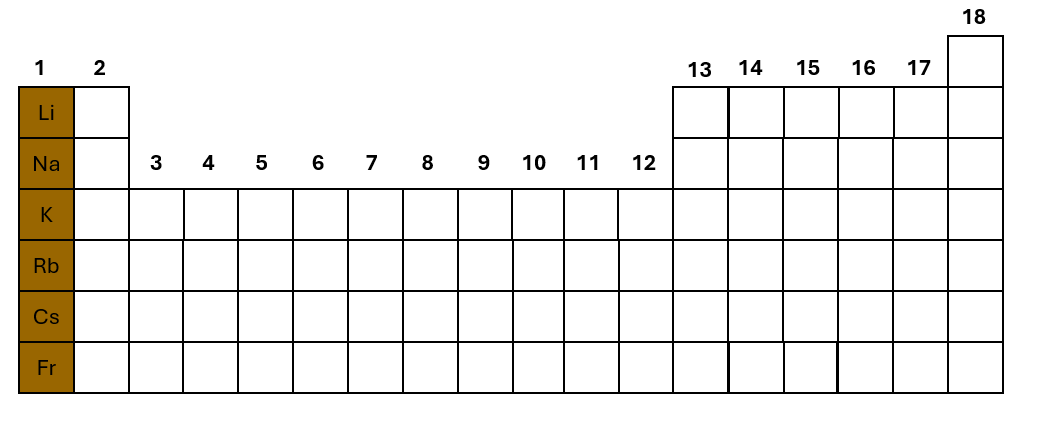
Group 1 of the Periodic Table contains the following elements: lithium (Li), sodium (Na), potassium (K), rubidium (Rb), cesium (Cs), and francium (Fr). These elements are called “Alkali Metals“.
PROPERTIES
They are usually visually lustrous and silvery in color. They have high thermal conductivity (they are capable of conducting energy in the form of heat) and electrical conductivity (the ability to conduct electric current).
They are quite chemically reactive; they react quickly when exposed to air, forming a layer of oxide of that element. Chemical reactivity increases as you move down the group.
When an alkali metal salt is exposed to a flame, the flame itself will produce the metal’s characteristic color. This practice is called the “Flame Test.”
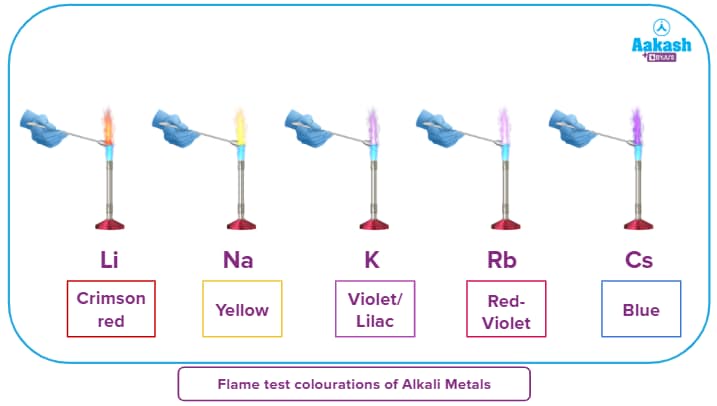
Credit: Flame Test: Colours, Procedure, Limitations & Applications | AESL
Group 2: Alkaline Earth Metals
DEFINITION
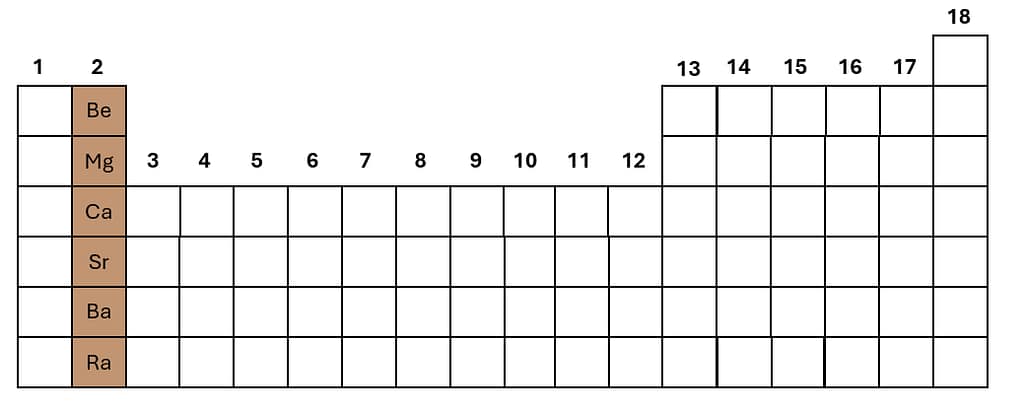
Group 2 of the Periodic Table contains the following elements: beryllium (Be), magnesium (Mg), calcium (Ca), strontium (Sr), barium (Ba), and radium (Ra). These elements are called “Alkaline Earth Metals“.
PROPERTIES
They are denser and less reactive than the alkali metals, but in terms of reactivity, they are generally more reactive than the main-group metals. As you move down the group, the atomic number increases (number of protons, and consequently more electrons, so the atomic weight increases), and the reactivity of the metals also increases.
The bonds in alkaline earth metals are usually ionic, based on electrostatic attraction. For example, Ca²⁺ (in aqueous solution) reacts with 2 (OH⁻) to form Ca(OH)₂ (solid state).
Group 3–12: Transition Metals
DEFINITION
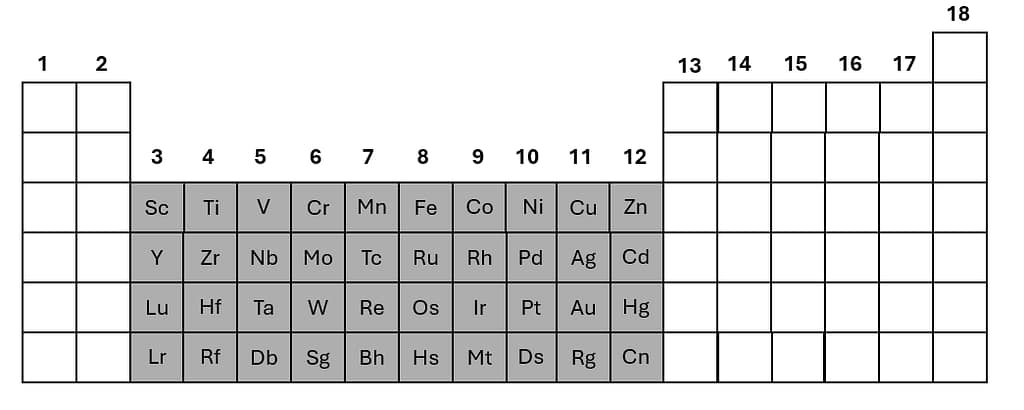
The most important elements are: titanium (Ti), vanadium (Vi), chromium (Cr), manganese (Mn), iron (Fe), cobalt (Co), nickel (Ni), palladium (Pd), platinum (Pt), copper (Cu), silver (Ag), gold (Au), zinc (Zn), and mercury (Hg).
PROPERTIES
They are malleable (a metal capable of being deformed into thin sheets without breaking) and ductile (a metal capable of being drawn into thin wires without breaking), and they conduct heat and electricity. Copper is one of the best conductors of electricity.
Manganese is a shiny, silvery-gray metal. Its chemical and biological versatility makes it an essential element in both metallurgy and biology.
Iron is an essential metal in modern society, used in a wide range of industrial and technological applications. Its susceptibility to corrosion requires appropriate protective measures.
Mercury is a liquid at room temperature. It is a good conductor of electricity, but it conducts heat less efficiently than other metals. It is ductile and malleable in its solid state.
Group 17: Halogens Gases
DEFINITION
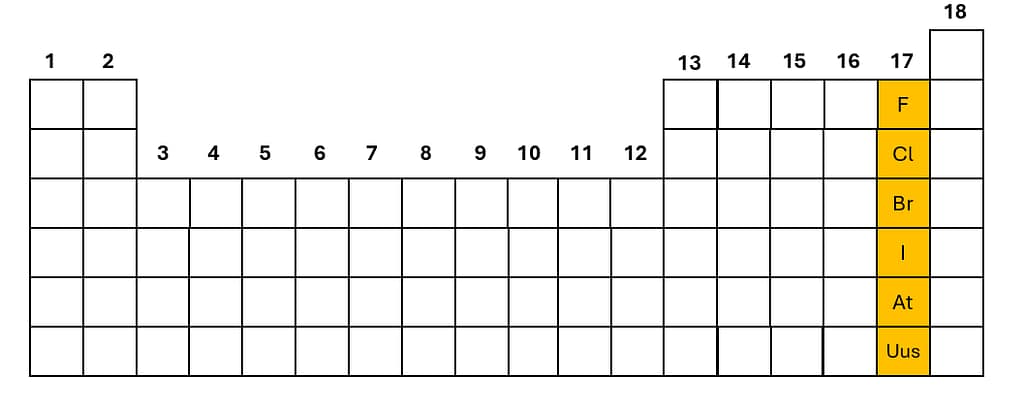
Group 17 of the Periodic Table contains the following elements: fluorine (F), chlorine (Cl), bromine (Br), iodine (I), astatine (At), and tennessine (Uus). These elements are called “Halogens Gases“.
PROPERTIES
All the elements in this group are nonmetals, so they exhibit no electrical or thermal conductivity. Fluorine is the most reactive nonmetal and the most reactive element of the periodic table. The chemical reactivity decreases as one moves down the group. Bromine is the only one that is a liquid at room temperature; the others are gases.
Fluorine can react with any other element in the periodic table except helium, neon, and argon. Chlorine gas is highly toxic, so much so that it was used as the first chemical weapon in 1915. Chlorination of water eliminates aquatic microorganisms that are harmful to human health, making the water safe to drink.
Group 18: Noble Gases
DEFINITION
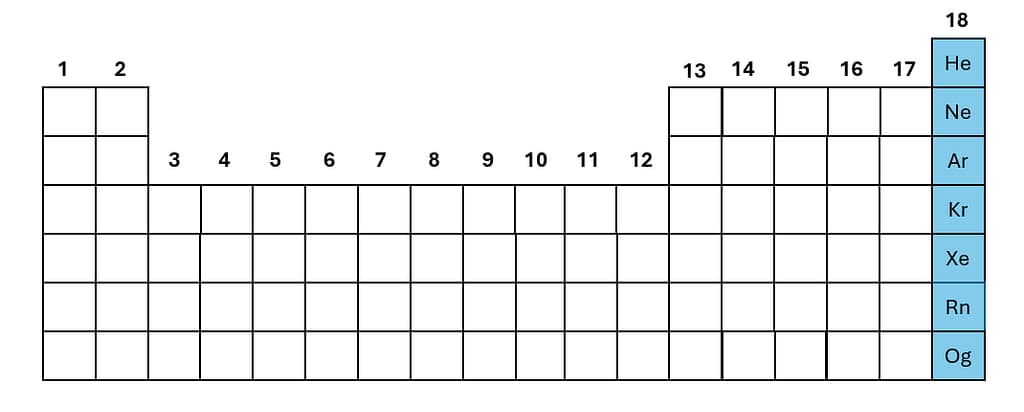
Group 18 of the Periodic Table contains the following elements: helium (He), neon (Ne), argon (Ar), krypton (Kr), xenon (Xe), radon (Rn) and oganesson (Og). These elements are called “Noble Gases“.
PROPERTIES
The elements in this group are the least reactive in the periodic table; therefore, they form few stable compounds. Only xenon is capable of forming many compounds. At room temperature, they are colorless and odorless. The density of these gases increases as you go down the group.
Helium is the most widely used of all the noble gases. Liquid helium is also used to cool nuclear reactors. Argon is the gas found in the atmosphere in significant quantities (0.93%).
Bibliographic sources:
- Geoff Rayner-Canham, Tina Overton (2014). Descriprive Inorganic Chemistry (6th ed.) by W.H. Freeman and Company.
Read more on Chemical Fundamentals 101:
Latest post: 03. The Periodic Table: Key Concepts to know – theChemistry