
| 🧪 The keywords are: Periodic table, Atomic weight, Atomic number, Atomic radius, Ionization energy |
Who discovered the Periodic Table?
Early Attempts at Classification
At the end of the 18th century, Antoine-Laurent de Lavoisier published a list of 33 elements that had been unknown until then, and he was the first to have the intention and determination to classify the elements he was gradually discovering.
In 1829, the German chemist Johann Wolfgang Döbereiner discovered three elements (thallium, sodium, and potassium) that exhibited similar properties.
In 1864, John Newlands proposed a classification method called the “Law of Octaves”: when elements are arranged in order of increasing atomic number (number of protons, positive charges), every eighth element exhibits similar physical and chemical properties. The eighth element was, in a sense, a repetition of the first. The Chemical Society and the scientific community rejected this method.
3 classification criteria
1. Recognizing analogies and similarities
They tried to identify similarities, such as the reactivity (ability to react) of the elements, by grouping them together, even though they lacked a deep understanding of the behavior of these elements. From a quantitative standpoint, they noticed that some of these elements had atomic weights equal to integer multiples of that of hydrogen. From this, one might have concluded that the elements were combinations of some fundamental unit of matter that coincided with the hydrogen atom.
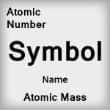
Atomic weight is the mass of a single atom, usually expressed in a.m.u., or atomic mass units. The atomic mass unit is defined as 1/12 of the mass of a single carbon-12 atom. Carbon-12 is the most abundant stable isotope of carbon and accounts for approximately 98.93% of natural carbon. An isotope is an atom of the same chemical element with the same number of protons but a different number of neutrons, and therefore a different mass.
2. Seeking algebraic formulas or geometric arrangements
They attempted to find numerical relationships between the equivalent weights (mass expressed in grams) of the elements, since it was difficult to determine them experimentally.
3. Seeking a natural order
The criterion that became the most important was natural order—an order predetermined by the periodic repetition of properties. The concept of periodicity developed about 10 years after the acceptance of the “Law of Atoms” formulated by Stanislao Cannizzaro, which determined how to assign atomic weights to the elements and led to the abandonment of previous criteria, in which researchers were forced to seek correlations even where none existed.
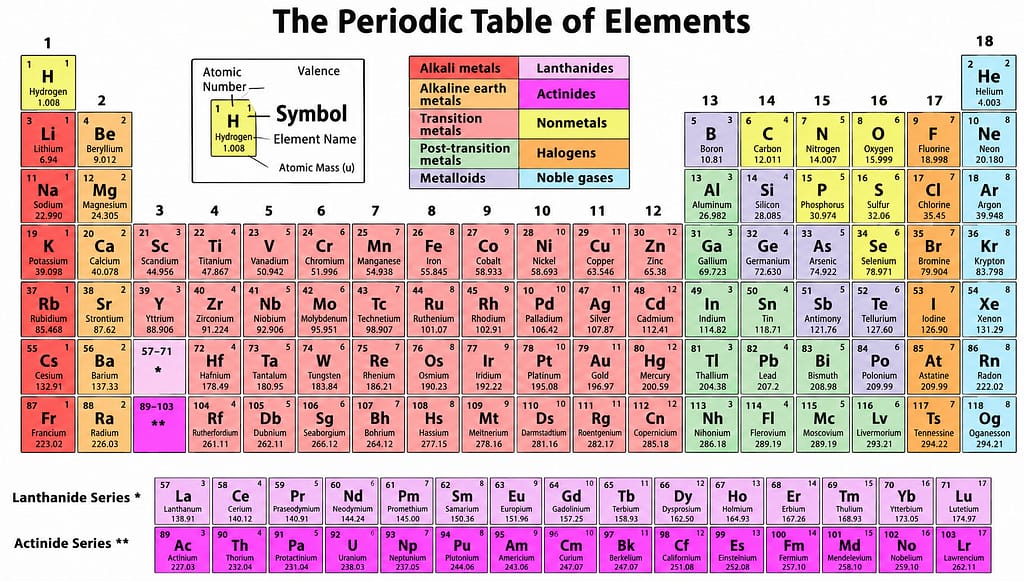
THE PERIODIC TABLE
The French geologist Alexandr Émile Béguyer de Chancourtois (1820–1886) was the first to recognize the periodicity of properties, which ruled out any individuality of the elements; each element could be—or not be—the sum of the elements that preceded it.
In 1869, the Russian chemist Dmitri Ivanovich Mendeleev identified a pattern of periodicity in the properties of the elements at specific, regular intervals. He developed what came to be known as the “Periodic Table,” arranging the elements in order of increasing atomic number (the number of protons, or positive charges) and noting the periodicity of certain properties that recurred. He organized it into groups and periods, arranging them horizontally, and discovered elements such as scandium, gallium, and germanium, which filled the gaps he himself had left, predicting their properties based on this periodicity.
Features of the Periodic Table
Groups and Periods
In Mendeleev’s periodic table, similar elements are found in the vertical groups, and their properties vary from top to bottom, forming horizontal periods. Across the periods, from left to right, the atomic number increases, and the elements exhibit similar properties. To date, there are 118 elements in the periodic table, of which about 90 occur naturally.
- 1 and 2 Groups: Alkali metals and Alkaline earth metals
- From 3 to 12 Group: Transition metals
- 17 Group: Halogen gases
- 18 Group: Nobles gases
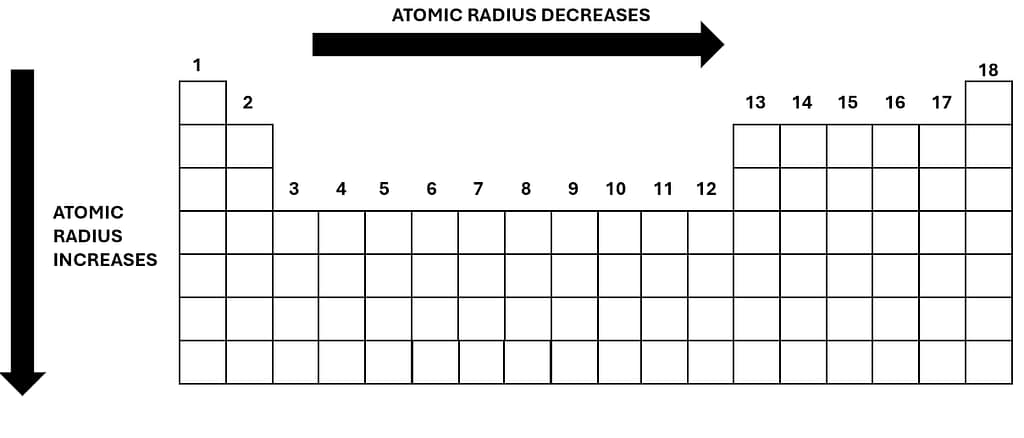
Atomic radius
There are two types of atomic radius, depending on whether the two atoms involved have a covalent or ionic bond. The radius is usually measured either in nanometers (1 nm = 10⁻⁹ meters) or in picometers (1 pm = 10⁻¹² m).
- The covalent radius is half the distance between the nuclei of two identical atoms that are covalently bonded.
- The ionic radius is half the distance between the nuclei of two identical atoms that are ionically bonded.
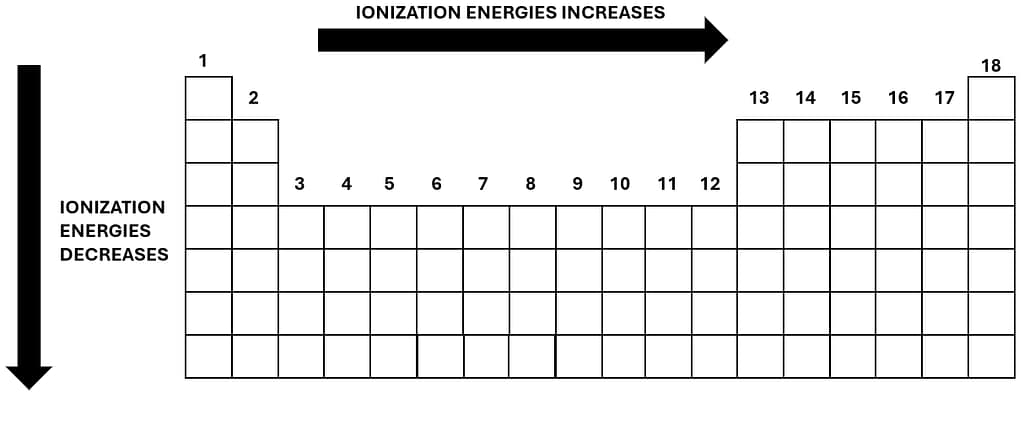
Ionization energy
Ionization energy is the amount of energy required to remove the most mobile electron (and thus the one farthest from the nucleus) from a gas-phase atom. The lower the energy required, the easier it is to remove the electron. It is measured in kJ/mol (kilojoules per mole of substance).
Bibliographic sources:
- Ralph H. Petrucci, F. Geoffrey Herring, Jeffry D. Madura, Carey Bissonnette (2017). General Chemistry: Principles and Modern Applications (11th ed.) by Pearson Education Canada Inc.
- A. Maggio, R. Zingales (2023). Notes from a Course on the History of Chemistry by EdiSES.
Read more on Chemical Fundamentals 101:
Latest post: 02. Atoms, Ions and Chemical Bonds – theChemistry