
| 🧪 What does the paper actually show? |
| Claim: Validation of a Pulsed High-Voltage Plasma Sterilizer, highlighting Its advantages over RF systems |
| Fields of application: Sterilization in healthcare settings |
Introduction
In this study, scientists at Silver Oak University (India) focused on validation of a Pulsed High-Voltage Plasma Sterilizer for the disinfection and sterilization of medical instruments to completely eliminate bacterial life. Common techniques that are widely used include steam autoclaving and ethylene oxide (EtO) gas sterilization. Scientists explained why this sterilizer is an inexpensive yet efficient alternative, allowing medical instruments to be safely reused by everyone once they have been sanitized.
This refers to the sterilization of metallic and non-metallic surgical instruments that can be sterilized multiple times without compromising their properties.
What is Pulsed High-Voltage Plasma Sterilizer?
Pulsed High-Voltage Plasma Sterilizer are cold sterilization systems, in which it is essential that the entire process takes place in vacuum or low-pressure chamber at low temperatures (45–50°C) enough to prevent medical instruments from overheating. A ceramic heater can be used to maintain this temperature range. The temperatures achieved are approximately 60% lower than those achieved with other methods, such as steam autoclaving.
The study focused on a pulsed high-voltage (300–400 volts) plasma sterilizer (short pulses with a frequency of 10–30 kHz, 10.000 to 30.000 pulses per second), which generates plasma (a collection of reactive charged particles, such as ions, derived from the gas) from the gas (rarefied air). This plasma is capable of cooling down and acting against bacterial life, destroying it. There are also plasma sterilizers that use radiofrequency energy, in which hydrogen peroxide (H₂O₂) is converted into plasma; this type is still the most commonly used today, although the use of a pulsed voltage is preferable because the plasma is obtained directly from the air, thereby avoiding the use of hydrogen peroxide.
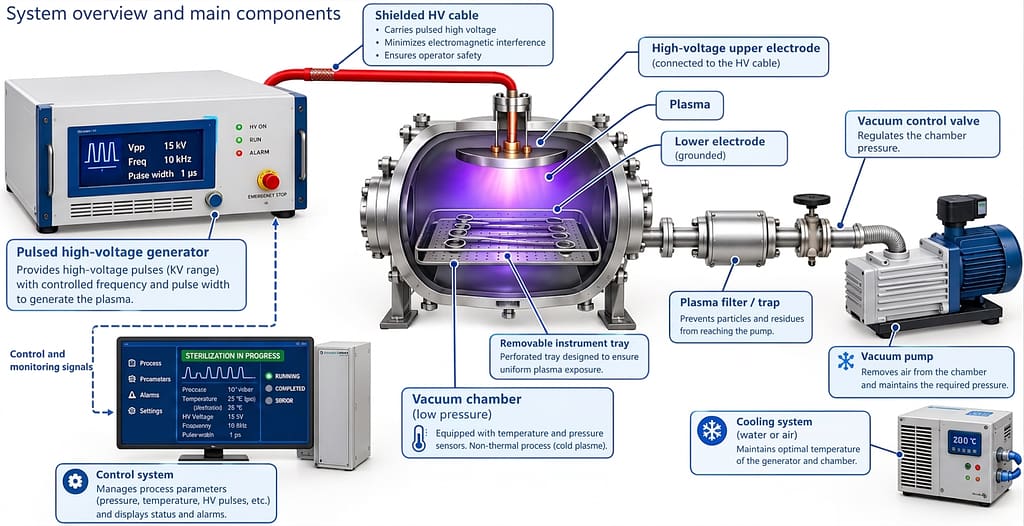
Applications of High-Voltage Plasma Generator
High-voltage plasma technology can be used in both sterilization and surface treatment and coating processes thanks to its high precision, energy efficiency, and process stability.
- Functional coatings on solar cells and microchips: The plasma applies the anti-reflective coating (ARC). Without it, much of the sunlight would be reflected off the glass and wasted. Deposition of barrier layers and insulating layers in microchips and beyond are facilitated by the use of plasma.
- Coatings for large architectural glass surfaces: The plasma as a pretreatment to improve the adhesion of coatings.
- Manufacturing of semiconductor components and flat-panel displays.
A plasma sterilizer is a complete system that also controls the surrounding environment; in fact, sterilization takes place in a vacuum or low-pressure chamber containing a plasma generator capable of producing plasma that performs the medical function of sterilization.
Advantages of Pulsed High-Voltage Plasma Sterilizer
The study compares sterilization using a pulsed high-voltage plasma generator with sterilization using a radiofrequency generator (RF). The parameters taken into account are:
- Frequency: In RF systems, a frequency of 13.56 MHz has been used, which is quite high (13.56 million Hz) compared to the pulsed plasma system (10–30 kHz, 10,000 to 30,000 pulses per second). Furthermore, RF systems require a sophisticated power distribution network to ensure power delivery.
- Operating Voltage: The pulsed plasma system operates at a voltage of 300–400 volts and is more effective than RF systems.
- Circuit Complexity: The circuits used in RF systems are usually 3 to 5 times more expensive because they are more complex. The pulsed plasma system is capable of using more common and readily available components, such as transformers and others.
- Cost: Therefore, the overall costs in a pulsed plasma system are lower for the circuit and its maintenance.
- Maintenance: The complexity of the circuitry and the need for specialized electrical networks in RF systems make maintenance difficult, even though they produce an incredibly uniform plasma—so much so that they are widely used. Pulsed plasma systems offer a cost-effective, simpler, and more practical alternative, all of which are factors to consider.
- Power Control: Pulse operation provides greater control over the duty cycle in a pulsed plasma system, optimizing plasma characteristics and reducing energy consumption.
Everything stated above is based on what was written in the scientific paper.
The importance of the study
This study highlights the major advantages of the Pulsed High-Voltage Plasma Sterilizer compared to RF systems. Today, it is essential—wherever possible—to reduce the costs and complexity of systems that are capable of achieving significant results in the field of sterilization while maintaining high performance. This system can be used in healthcare settings where resources are limited.
Bibliographic sources:
- Somya Gupta and Devansh Desai and Saurin Shah. Design, development, and experimental validation of an indigenous pulsed high-voltage plasma sterilizer for low-temperature medical applications. Fundamental Plasma Physics, 2026. DOI: https://doi.org/10.1016/j.fpp.2026.100129
Read more on Biochemistry:
Latest post: “BioPykrete”: Ice as strong as concrete – theChemistry