
| 🧪 What does the paper actually show? |
| Claim: ”BioPykrete”, a sustainable biocomposite |
| Fields of application: It has the potential to be used as a building material in Arctic environments |
Introduction
Scientists at the Hebrew University of Jerusalem have created ice that is 10 times stronger than the ice we are all familiar with, to address the weakness of ordinary ice, which shatters more quickly due to cracks.
This is called BioPykrete, and it requires about 70 times more energy before breaking than ordinary ice. This means it can withstand much higher temperatures before melting.
Characteristics and uses of ordinary ice
Ordinary ice is inexpensive and abundant, but it has cracks that easily spread, causing the hexagonal crystal structure to break.
In the laboratory, it is possible to produce numerous other crystal structures besides the hexagonal one. This structure leaves empty spaces (cavities) within the lattice and, as a result, has a density (0.92 g/cm³) slightly lower than that of water (about 1 g/cm³), which allows it to float.
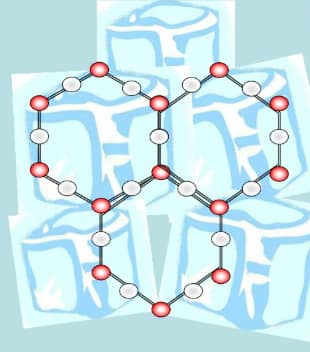
This is a hexagonal crystal structure in which the red atoms are oxygen atoms and the white atoms are hydrogen atoms.
Fields of application:
- Food Preservation: keeps food and beverages fresh by slowing bacterial growth
- First aid: when applied to bruises, sprains, or swelling, it reduces pain and inflammation (cryotherapy)
- Preservation of organs and biological samples: ice (or refrigerant mixtures) keeps organs, blood, and tissues at controlled temperatures during transport
- Industrial refrigeration: in chemical, pharmaceutical, and food processing
How they did it?
BioPykrete is a sustainable biocomposite produced by mixing nanocrystals (5–20 nm wide, 1 nm = 10⁻⁹ m) of cellulose (CNC) with a chimeric protein capable of bonding to both the cellulose and the ice components. Cellulose is the compound found in tree trunks and plants in general. The chimeric protein was produced in the laboratory by combining two different proteins: Carbohydrate-Binding Module 3a and Antifreeze Protein type III.
- Carbohydrate-Binding Module 3a naturally binds firmly to crystalline cellulose
- Antifreeze Protein type III is a type III antifreeze protein found in certain fish that live in polar waters. It has the ability to bind to ice crystals, preventing their growth to make the structure as compact as possible
Overall, this results in a three-dimensional structure in which the chimeric protein—thanks to its two different proteins—serves to hold the structure together, preventing cracks from spreading and increasing the amount of energy (in the form of heat) required to cause the structure to break.
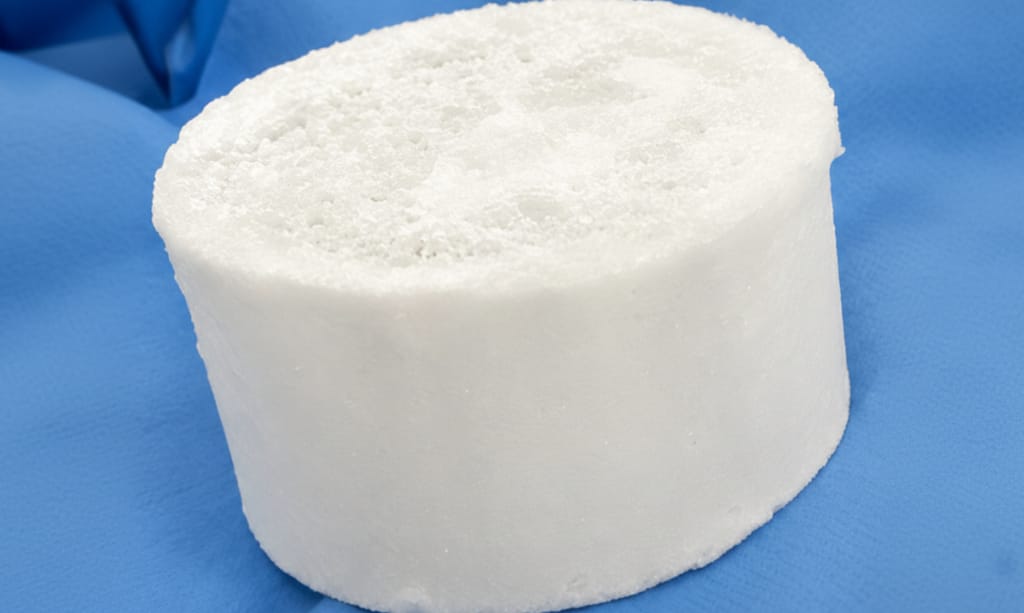
Pykrete from World War II
During the WW II, Geoffrey Pyke proposed Pykrete in 1942, a material made of 14% sawdust (or other fibers like newspaper) and 86% ice. It is stronger and melts more slowly than regular ice. The main difference from BioPykrete lies in the use of a special protein that stops cracks from spreading, helping keep the structure strong and solid.
It was conceived as a potential material suitable for building a massive, unsinkable aircraft carrier but the idea was never carried out due to technical and cost issues.
The importance of the study
Its exceptional strength, comparable to that of traditional concrete, makes BioPykrete a viable material for infrastructure in glacial environments. However, further durability, freeze-thaw, abrasion, and life-cycle testing will be necessary. The use of a chimeric protein opens the door to a new world of sustainable, low-carbon biocomposites in Arctic environments where traditional construction is economically and environmentally challenging.
High-quality construction materials are scarce and expensive, while the construction process itself requires significant energy and specialized care. Standard concrete must be kept above 5°C for about 30 days to reach full strength, and this requires insulated structures, constant monitoring, and the use of chemical accelerators.
Bibliographic sources:
- Scientists create ‘super ice’ that is ten times stronger and far harder to shatter – PHYS ORG, 2026
- Biomimetic engineering of a fortified ice composite with enhanced mechanical properties – ScienceDirect – ScienceDirect, 2026
Read more on Biochemistry:
Latest post: Coffee grounds: production of biofuels – theChemistry