| 🧪 The keywords are: chemical formulas, mole, law of conservation of mass and definite proportions |
What Are Chemical Formulas?
CHEMICAL FORMULAS
A chemical formulas are represented by the symbols of the elements that make up the molecular or ionic compound.
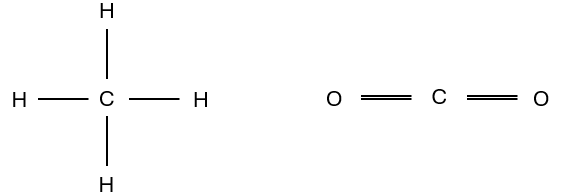
- CO₂ is an example of a chemical formula that describes the molecular compound known as “carbon dioxide.” It consists of 1 carbon atom and 2 (footnote) oxygen atoms. O = C = O (‘=’ is a double bonde). A molecular compound is formed through covalent bonds (the sharing of electrons, e-) between different atoms. There are single bonds (each atom shares 1 e-), double bonds (each atom shares 2 e-), and triple bonds (each atom shares 3 e-).
- NaCl is an example of a chemical formula that describes the ionic compound known as “sodium chloride” (table salt). It consists of one positive Na+ ion and one negative Cl– ion. The ionic compound is formed through an electrostatic interaction between the two oppositely charged ions.
TYPES OF CHEMICAL FORMULAS
- Empirical (or minimal) formula: This is the simplest formula and is usually not very helpful when dealing with compounds. For example, the molecular formula of a compound is P₄O₁₀, and its empirical formula is P₂O₅.
- Molecular formula: It consists of the symbols of the elements and represents the actual molecule. CO₂ and H₂O are examples of actual molecules. It tells us the ratios of atoms in a compound but says nothing about its structure.
- Structural formula: It shows us the connections between atoms and the types of bonds.
The Concept of a Mole
A mole is the unit of measurement for the amount of a substance. One mole contains an extremely large number of elementary species (atoms, ions, molecules, and others). The total number of these molecular species is represented by Avogadro’s Number, which is 6.022 × 10²³ (mol⁻¹). Therefore, one mole contains Avogadro’s Number.
Avogadro’s number was chosen such that the mass of one mole of carbon-12 atoms (an isotope of carbon —an atom of the same chemical element that has the same number of protons but a different number of neutrons) is 12 grams.
1 mol of H2O = 18,016 grams of H₂O (1.008 atomic mass units of H + 1.008 atomic mass units of H + 16 atomic mass units of O) = 6.022 × 10²³ H₂O molecules
Law of Conservation of Mass
In 1774, following an experiment that convinced him that oxygen in the air was necessary for combustion reactions, Antoine Lavoisier stated that:
“The mass of the reacting substances (reagents) at the start is equal to the mass of the substances obtained at the end of a reaction.” -Lavoisier
Hence the famous saying that matter is neither created nor destroyed, but transformed.
Law of Definite Proportions
In 1799, Joseph Louis Proust stated that:
“When two or more chemical elements react to form a compound, they always combine in fixed and constant mass ratios, regardless of the amount of compound.” – Proust
For example: If I had a sample of substance A, consisting of 10 g of H₂O by mass, and if I had a sample of substance B, consisting of 15 g of H₂O by mass, both samples would have the following mass percentages: %H = 11.79 and %O = 88.81 (already take the 2 oxygen atoms into account).
Bibliographic sources:
- Ralph H. Petrucci, F. Geoffrey Herring, Jeffry D. Madura, Carey Bissonnette (2017). General Chemistry: Principles and Modern Applications (11th ed.) by Pearson Education Canada Inc.
Read more on Chemical Fundamentals 101:
- 05. Chemical Formulas explained: The Laws of Conservation of Mass and Definite ProportionsChemical formulas represent the elements in molecular or ionic compounds, such as CO₂ for carbon dioxide and NaCl for sodium chloride. They can be empirical, molecular, or structural, each providing different information about the compound. Empirical formulas show simplest ratios, while molecular formulas indicate actual ratios and structural formulas illustrate atomic connections.
- 04. The Properties of Groups in the Periodic TableThe text discusses elements in Groups 1, 2, 3-12, 17, and 18 of the Periodic Table. Alkali and alkaline earth metals are reactive, with distinct conductivity properties. Transition metals are malleable and ductile. Halogens are nonmetals, lacking conductivity, while noble gases are very unreactive, colorless, and odorless.
- 03. The Periodic Table: Key Concepts to knowThe Periodic Table’s origins trace back to Antoine-Laurent de Lavoisier’s 18th-century elemental list and Johann Wolfgang Döbereiner’s discovery of elemental similarities in 1829. John Newlands later proposed the “Law of Octaves” in 1864, though it faced rejection. Key classification criteria include recognizing similarities, algebraic formulas, and natural order.