| 🧪 What does the paper actually show? |
| Claim: ”Bioloon”, a baloon that degrades in 9 months and is completely biodegradable |
| Fields of application: For celebrations, while reducing the environmental impact |
Introduction
Balloons are beautiful; they’re usually used to celebrate someone, whether it’s a birthday or a milestone. They can also be a source of fun for children. Unfortunately, few people are aware of the environmental damage they can cause. Balloons—whether foil or latex—are considered extremely harmful because they pollute marine life. Research shows that about 80% of the waste found in the stomachs of sea turtles consists of parts of balloons.
Soft tissues from them can be about 30 times more dangerous to sea turtles than rigid microplastics. In the future, they will break down into microplastics, and it will take about 6 years for them to degrade. What you’re about to read today is a way to produce balloons so that they can be used purely for fun without causing environmental damage.
Type of balloons
- Latex: products made from natural rubber are biodegradable, but the degradation process can take years. They can harm both aquatic animals that ingest these pieces of latex and wildlife when these pieces settle on the forest floor.
- Foil (or Mylar): they are made of metallized polyester; they retain helium better but are not biodegradable (more harmful to the environment) and have a fixed shape, unlike the latex, which is more elastic. They are much more durable than latex balloons, and if stored properly after being deflated, they can be reused several times.
There is also a global initiative called “Balloons Ban” aimed at reducing pollution by banning the sale of helium balloons. Rhode Island was one of the first cities to ban their sale, imposing fines on violators. Some cities in Australia and the State of California are participating in this initiative.

What is the new balloon?
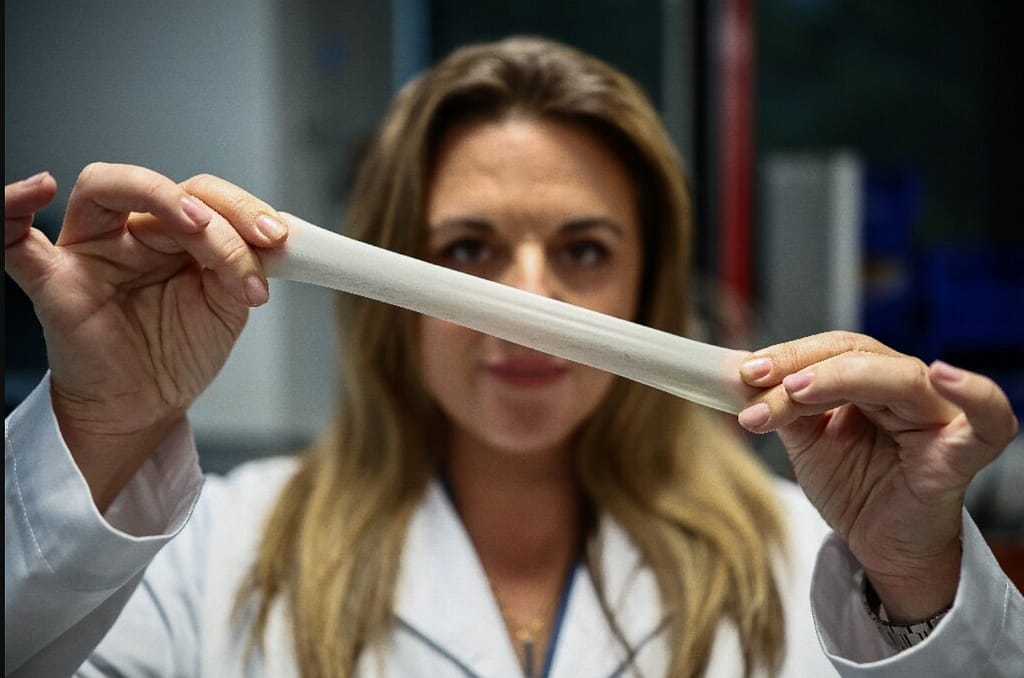
Researchers at Imperial College London have developed a prototype of a completely biodegradable balloon in the lab, which they have named “Bioloon.” This is an incredible achievement, and they hope to bring it to market within two years. According to the researchers, it is no more expensive than traditional ones and inflates more easily.
This achievement is the result of a collaborative effort in the lab and the dedication of Charlotte Melia, an event entrepreneur who describes herself as an environmentalist and, for that reason, felt compelled to find a solution to the problem of traditional balloons that harm the environment. So, to fund this project, Charlotte Melia and a business partner decided to invest £30,000 ($41,000).
Differences from traditional balloons
The starting point is the only thing they have in common. They both begin with natural latex derived from the sap of the rubber tree, which is native to the Amazon rainforest. The real big difference comes right after that. To produce the traditional balloons, sulfur accelerators, antioxidants, and activators are subsequently added through a process called “sulfur vulcanization.” These additives are used to prevent biodegradation but release toxic substances into the environment (heavy metal salts or nitrosamines).
Bioloon, on the other hand, is produced by mixing natural latex with long biodegradable polymer chains without adding those additives. It has been tested in seawater, soil, and deionized water (free of mineral salts).
Importance of the study
Most balloons, even those marketed as biodegradable, are not 100% biodegradable, and their degradation times are significantly longer than those of “Bioloon.” Longer degradation times mean that environmental damage persists for years.
“Bioloon,” on the other hand, degrades in 9 months and is completely biodegradable. The Department of Engineering at Imperial College London has estimated that between 20 and 25 billion balloons are purchased worldwide each year. The development of “Bioloon” represents a major step forward in protecting the environment.
Bibliographic sources:
- Plastic Balloons: How They Pollute – Don’t Waste – Tutto per uno sviluppo sostenibile, 2026
- Blowing in the wind, humble balloon gets green makeover – PHYS ORG, 2026
- Scientists invent ‘world’s greenest balloon’ – BBC, 2026
Read more on Green Chemistry:
Latest post: From plastic waste to green hydrogen: it’s possible! – theChemistry
Thank you for reading