1. Introduction
Plastic mixed waste can now be used in a chemical process to produce clean hydrogen—a type of renewable energy generated without CO₂ emissions—as demonstrated by a team led by scientists from the UCLA Samueli School of Engineering and Ewha Womans University in South Korea, who successfully studied a method previously applied only to biomass, such as algae. Plastic takes a very long time to degrade, which contributes to global pollution. Another problem is mixed plastic waste, which is disposed of all together, making conventional recycling methods more difficult or even ineffective.
2. Importance of the study
It is absolutely essential to find ways to recycle plastic waste, the accumulation of which has extremely serious repercussions on biodiversity, human health, and the health of oceans, rivers, and lakes. Every year, 430 million metric tons of plastic are produced, half of which is single-use. About 10% of plastic comes from recycling, and about 12% is incinerated. Incineration is absolutely harmful to everyone; combustion produces toxic gases such as carbon monoxide. We need greater awareness and understanding of this issue; we need to make people realize that plastic waste pollution is not a topic to be dismissed or considered less important just because it’s about the environment and nobody cares.
My note: I want to make it clear that this article is not intended to be a standalone scientific study. Through this blog, I hope to carefully share scientifically relevant information. If you’d like to explore this topic in greater depth, I invite you to refer to the links to the scientific research that I’m sharing here so you can analyze all the results.

3. What is clean hydrogen used for?
Clean hydrogen can be used in:
- Automotive industry: powering vehicles with fuel cells.
- Electricity Storage and Grid Balancing (Power-To-Gas): in winter or at night, that hydrogen is converted back into electricity using fuel cells or turbine. Power-to-Gas technology allows electricity to be stored in the form of hydrogen or methane.
- Ammonia (NH₃) production: ammonia is the basis for agricultural fertilizers. Today, gray hydrogen (derived from methane gas, which is highly polluting) is used; switching to green hydrogen would make food production sustainable. CO₂ and CH₄ are greenhouse gases that absorb the infrared solar radiation emitted by the Earth’s surface, clouds, and atmosphere that strikes the Earth, causing a global rise in temperatures.
- Heating and Residential/Commercial Use: inject up to 20% green hydrogen into natural gas pipelines to immediately reduce emissions without replacing boilers.
4. Benefits of this study
This study offers 3 main advantages over conventional recycling of mixed plastic waste: it operates at low temperatures, captures most of the CO₂ rather than releasing it into the environment, and processes mixed plastic waste. Conventional plastic recycling involves sorting and high-temperature gasification, which releases significant amounts of CO₂. Gasification is a technique used to convert carbon-rich substances into a combustible gas mixture through high heat and a controlled amount of oxygen. Finding a good way—one that isn’t harmful to the environment—to use all this plastic in processes that could potentially allow us to produce green substances like clean hydrogen should be the challenge of our time.
5. How did they do it?
The method is based on ATT (Alkaline Thermal Treatment), which can convert common plastics such as polyethylene terephthalate (PET), polyethylene (PE), and polypropylene (PP) to produce clean hydrogen within a single reactor. NaOH-assisted ATT causes the plastics to decompose.
PE and PP were initially thermally preoxidized (heated in air at 150 and 350 °C, exceeding their melting points) because it had been observed that they produced less hydrogen. Their carbon-hydrogen bonds are resistant to alkaline treatment.
PET reacted well and contains bonds with carbon, hydrogen, and oxygen.
NaOH acts as a catalyst to enable the reaction to occur at lower temperatures (approximately 300–400°C) compared to other catalysts. NaOH reacts with the released carbon to form Na₂CO₃, and the NaOH is regenerated as Ca(OH)₂.
ATT is also a method that processes mixed plastic waste without requiring extensive sorting. This is a major advantage for a technique that will certainly be further developed to achieve industrial-scale yields (and thus produce a large quantity of clean hydrogen).
6. Results
6.1 Yields obtained The yields obtained for PET, PE, and PP, respectively, are: 43.7, 51.9, and 30.2 mmol/gplastic. The study was originally tested on algal biomass, which yielded 69.69 mmol of H₂ per gram of algae as the best result.
6.2 Comparison of SG-PET and ATT-PET
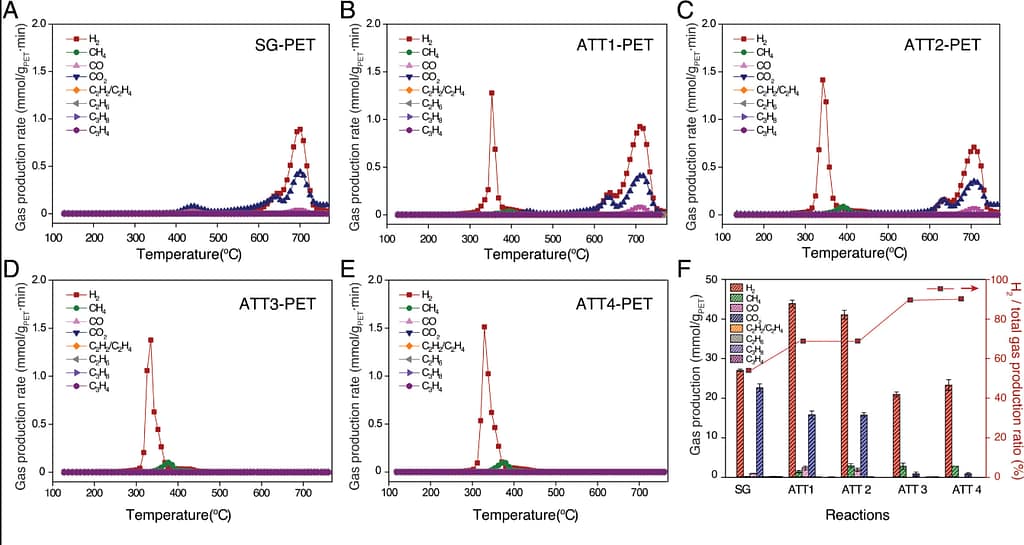
Photo from Selective and direct hydrogen generation from mixed plastic waste via alkaline thermal treatment with inherent carbon storage | PNAS. Gas production rates during the decomposition of PET under different reaction conditions. SG-PET refers to gasification. A comparison between SG and ATT for PET is provided, and it can be seen that SG occurs at 700°C, a temperature significantly higher than that of ATT. Figure F is overall gas production under each reaction condition.
ATT1- PET: NaOH-to-PET mass ratio of 1:1
ATT2-PET: NaOH-to-PET mass ratio of 2:1
ATT3-PET: NaOH-to-PET mass ratio of 3:1
ATT4-PET: NaOH-to-PET mass ratio of 4:1
What can be seen from the graph is that as the amount of NaOH increases, H₂ is produced at increasingly lower temperatures compared to the SG.
Figure F shows that ATT1-PET, which has a NaOH-to-PET ratio of 1:1, produces the greatest amount of H₂ compared to subsequent reactions in which the amount of NaOH is increased. This is because ATT1-PET also contains H₂ that forms at approximately 700°C, and thus the two amounts add together. The research assumes that, in the presence of large amounts of NaOH, the H₂ that forms remains trapped in intermediate products rather than being released as gaseous H₂.

Photo from Selective and direct hydrogen generation from mixed plastic waste via alkaline thermal treatment with inherent carbon storage | PNAS. The overall reaction of ATT-PET.
If you’re curious, you can check out the results for PE and PP, which required thermal oxidation to increase their reactivity and H₂ yield.
Bibliographic sources For more info Selective and direct hydrogen generation from mixed plastic waste via alkaline thermal treatment with inherent carbon storage | PNAS
Thank you for reading