Introduction
Neon is a noble gas that belongs to Group 18 (VIII) according to IUPAC nomenclature and is the second noble gas after helium. “Noble” refers to its ability to remain unreactive (inert, with very low reactivity) with its surroundings, which is due to the fact that it has a complete valence shell with 8 electrons and is stable as a single atom. It is colorless and odorless, just like helium. Its main uses include illuminating advertising signs and fluorescent lamps for traffic signals, and it is a component of laser mixtures. It is present in abundance in the Earth’s atmosphere in trace amounts, about 0.0018%.
How can you get it?
Neon gas is produced industrially through the fractional distillation of liquid air. Air is compressed to high pressures and cooled until it becomes liquid (cryogenic temperature), and is then slowly heated. Through distillation, neon is separated from other components such as nitrogen and oxygen. The resulting gas is purified through selective adsorption processes to achieve a high purity of 99.99%.
Fractional distillation is a common technique used in laboratories to separate components from a mixture by exploiting the boiling points of the mixture’s components. Multiple heating/condensation cycles are carried out, during which the substance with a low boiling point evaporates first and is condensed to convert it from a gas to a liquid.
Fields of application
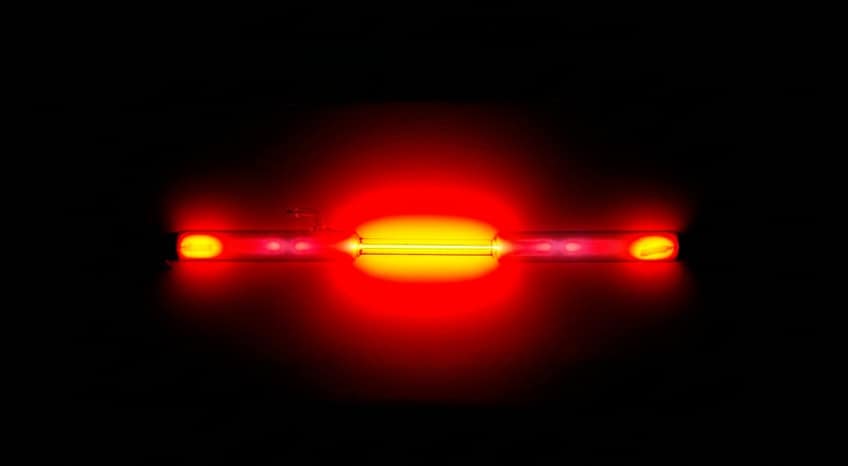
The unique feature of neon is that when an electric current passes through it, it emits a reddish–orange light (radiation). Used in:
- Illuminated signs and decorative lights
- High-Voltage indicators: indicator lights for electrical panels and circuits
- Gas lasers: specialized lasers also used in eye surgery
- Particle detector: used in physics research to track subatomic particles
- Diagnostic gas: used in a gas analyzer for pulmonary diffusion testing
- Neon Radiotherapy: it has been observed that neon light yields better results for various types of tumors than high-voltage X-rays
The first neon lamps
The first neon lamps were produced after it became possible to separate neon from air—a feat first achieved in 1898 by William Ramsey (1852–1916), who named the gas he had just separated “neon.”
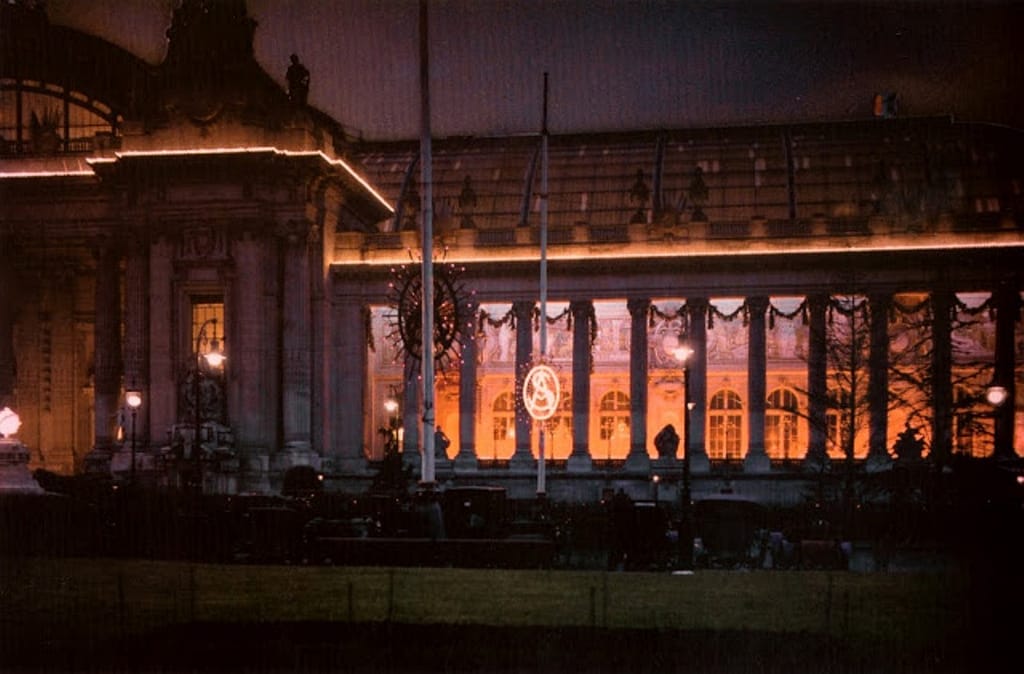
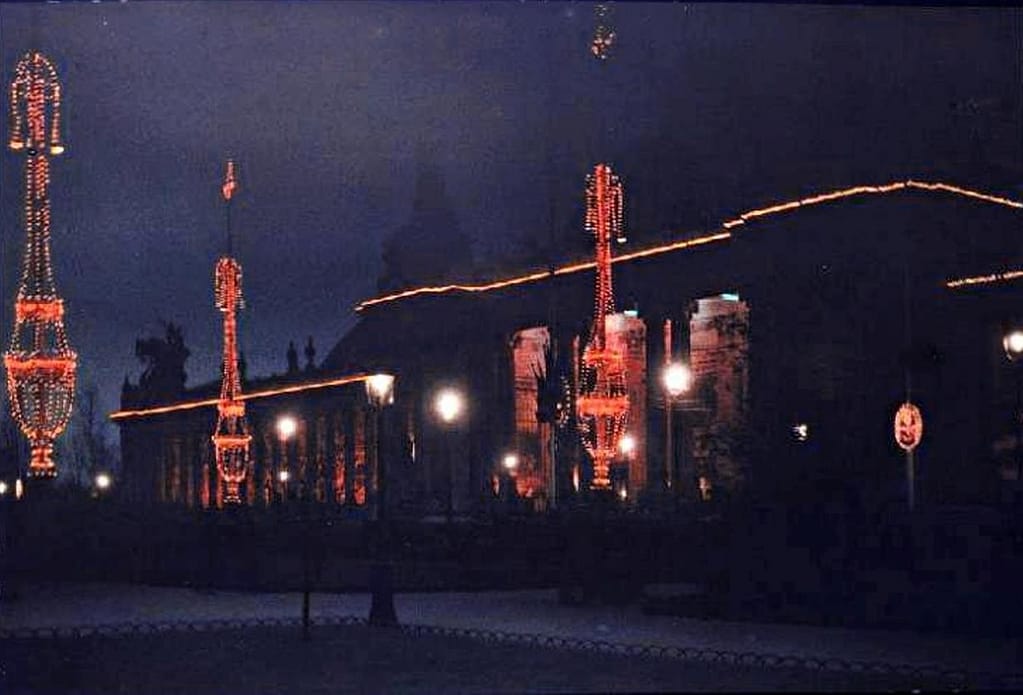
To produce the lamps, a machine invented by the french engineer Georges Claude (1870–1960) was used. Claude succeeded in producing the first lamps, which were presented to the public at the 1910 Paris Art Exhibition. After the interlude of World War I (1914–1918), neon lamps began to become increasingly widespread. It was also discovered that mixing neon gas with other noble gases could produce green and blue lights.
Precautions
It is not toxic, but prolonged exposure of containers holding neon to heat or fire can cause the container to rupture violently. Contact with liquid neon can cause frostbite (melting point: -259°C). If inhaled, it can cause: asphyxia, dizziness, and headaches.
Bibliographic sources:
https://www.thecinetourist.net/neon-paris-c1913.html